
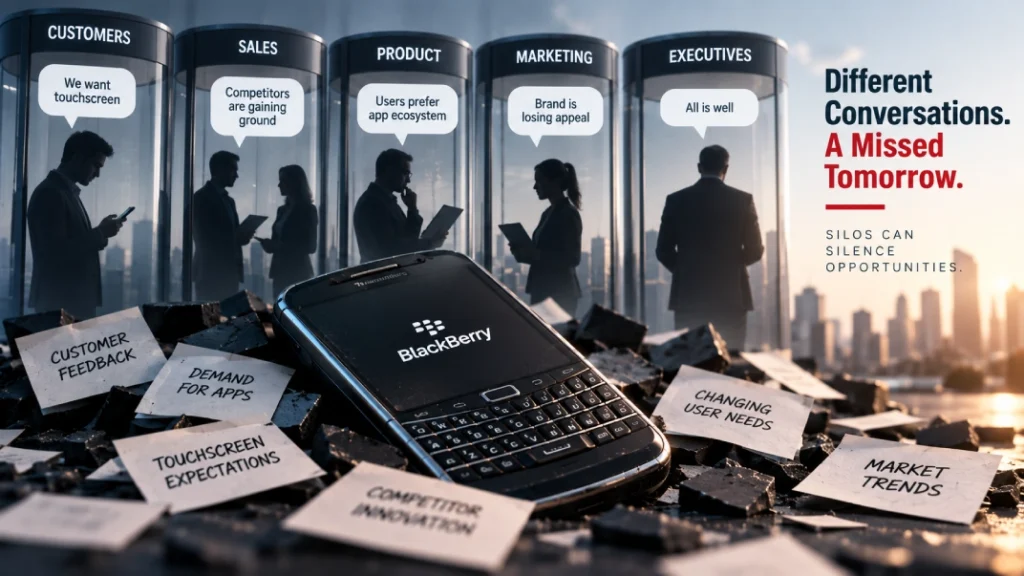
Research In Motion (BlackBerry) once stood as the undisputed titan of enterprise mobility. Its physical keyboards and proprietary end-to-end security made it indispensable to heads of state, bankers, and Fortune 500 executives. Yet, within five years, BlackBerry tumbled into market irrelevance.
Its failure was not caused by technological incapacity, but by listening to only one stakeholder group while remaining deaf to the wider ecosystem.
The Enterprise Echo Chamber
BlackBerry practiced siloed listening. The leadership team tuned in almost exclusively to traditional enterprise IT managers and corporate network administrators. These stakeholders prioritized battery conservation, bandwidth thriftiness, and administrative security above all else.
By taking input solely from enterprise buyers, BlackBerry convinced itself that smartphones were utilitarian work terminals rather than multi-purpose computing platforms.
Deaf to the Consumerization Wave
While BlackBerry reassured corporate IT departments, a decisive signal was emerging from end-users: the consumerization of enterprise technology. Professionals no longer wanted separate devices for work and life. They wanted capacitive touchscreens, open app stores, media players, and seamless web browsing.
BlackBerry dismissed Apple’s original iPhone as an unreliable toy with an impractical touchscreen and poor battery efficiency. By invalidating user signals as trivial distractions, BlackBerry misjudged the driving forces of product adoption.
Misreading the Ecosystem Shift
When employees began demanding “Bring Your Own Device” (BYOD) policies, corporate IT departments conceded to user preference. BlackBerry had no contingency plan. Because leadership lacked continuous listening mechanisms across its broader stakeholder spectrum—everyday end-users, software developers, and carrier partners—it failed to register that its core market moat had evaporated.
The Strategic Takeaway
A customer is not just the person approving the corporate purchase order; it includes the human beings using the product daily. Confining intelligence loops to a single stakeholder segment guarantees catastrophic blind spots when market dynamics shift.