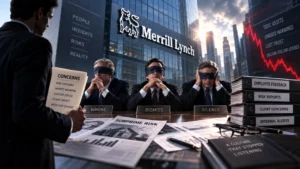
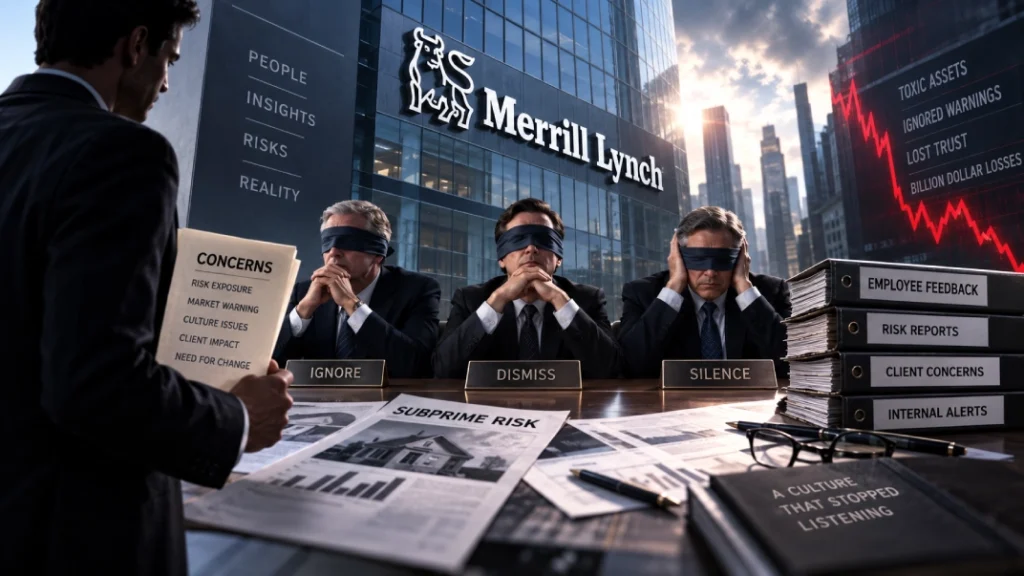
When Merrill Lynch was forced into a distressed emergency sale to Bank of America in September 2008, it marked the humiliating end of a 94-year Wall Street legacy. While commonly framed as a casualty of the subprime mortgage meltdown, Merrill’s downfall was fundamentally driven by the deliberate suppression of stakeholder intelligence and internal risk signals.
Absolute Intolerance of Internal Dissent
Under CEO Stan O’Neal, the firm instituted a culture hostile to contrary views. Executives and risk managers who voiced concerns regarding aggressive underwritings in Collateralized Debt Obligations (CDOs) were routinely sidelined or terminated.
In September 2006, Merrill Lynch’s own equity research analysts issued direct warnings that firms exposed to subprime debt faced severe revenue destruction. That very same month, leadership ignored its own analysts’ intelligence and acquired subprime lender First Franklin Financial for $1.3 billion.
Circumventing Market Signals via “The Subsidy”
Frontline risk signals continued to flash red, only to be systematically bypassed. Seasoned traders refused to buy the senior tranches of Merrill-issued CDOs, citing obvious systemic vulnerabilities and a complete lack of outside buyers. In one case, a trader who rejected the $1.5 billion Octans CDO was ousted.
To keep the issuance pipeline running, management created an artificial feedback loop known as “the subsidy.” The originations division shared bonus fees—often “a million for a billion”—with an internal trading desk simply to warehouse toxic inventory that the open market rejected.
Boardroom Abdication
Rather than interrogating the ballooning $32 billion exposure, Merrill’s board failed to exercise independent oversight. They accepted manufactured accounting stability until an unprecedented $8.3 billion quarterly loss exposed the reality, erasing decades of enterprise equity.
The Strategic Takeaway
Risk intelligence is worthless if leadership penalizes the messenger. When an organization disables internal checks, ignores market pushback, and manufactures artificial validation, failure is an engineered certainty.